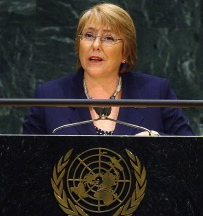
Why women need good presentation skills

May 28, 2013

Former Chilean president Michelle Bachelet

Recently I got this email from a friend and listener to the show who had attended a series of presentations by budding entrepreneurs:

"I noticed a GAPING chasm between the way the women presented to the group and the men. Their projects were equally valuable and interesting, but the men tended to speak very confidently and in a way that made it easy to listen and get excited about their project. The women were much less commanding up there...They tended to go up at the end of their sentences, trail off, and be non-declarative. It made me much less interested in their work."

I've had similar experiences myself lately. I've been to a couple of conferences where the lousiest talks were given by women. What really hit me was that some of the worst offenders were speaking at a women's conference. I came into the room late to hear a senior executive at a famous global retailer finishing off her speech in a monotone, clearly reading from a script. Yawn. An hour or so later one of the women running the conference got up to tell people what the agenda was after lunch. But no one could hear her because they were all talking amongst themselves. She didn't command our attention by coming on stage with something like, 'Before you go, I'd like to tell you a few things about the afternoon'. She didn't command the room. Like so many women, she approached her task tentatively, afraid to take a stand and shut us up forcefully (but politely), as she could have done. Instead, she kept speaking in a soft voice, and most of us kept ignoring her. Rude, yes, but this woman did nothing to engage her audience. She didn't deserve our attention.

Why does this matter? Because if women don't speak well and present our ideas clearly and compellingly, people won't take us and our ideas and products seriously. As my correspondent above also pointed out:

"It got me thinking, this has to be happening in workplaces and conferences all over the place. It's got to affect financing that women are not getting, projects their firms are not getting, etc."

I'm sure it is. What I don't understand is why these women - especially those who must speak publicly as part of their jobs - aren't being trained properly in presentation skills. This type of training is invaluable. Take it from me, a reluctant and relatively new public speaker.

Presentation tips:

  • Your voice is so important. You need to speak relatively slowly (which can be tough when you're nervous), clearly, and take frequent pauses to enable people to take in what you've just said.
  • As one of my presentation trainers, Stacy-Marie Ishmael, often points out, you must make eye contact with different members of the audience as you speak. It really helps connect you to them. She recently linked some of us on her newsletter list to this HBR piece by TED founder Chris Anderson on how to give a great presentation.
  • Don't go in thinking people want you to fail. They don't. The audience is actually rooting for you. After all, no one wants to sit through a boring presentation. On the contrarary, we're all eager to be entertained.
  • The reason many women suck at presenting is that we are far likelier than men to suffer from a lack of confidence. That comes through loud and clear in a presentation. If you don't believe in yourself, how do you expect the audience to buy whatever it is you're talking about or trying to sell? This is a wider issue, one that can't be neatly taken care of in presentation training, but being aware of it should at least help move the needle a little.
  • Watch yourself present - get someone to tape you practicing your presentation - which you MUST do, time and again, to feel confident on the day - or just tape yourself. Then play the video back, and cringe. Yes, cringe, but then improve. Change the bits that aren't working.
  • If, like me, you are someone who genuinely enjoys communicating with people, let youself go and actually enjoy your talk. I really like people (most of the time). What helped me was thinkng of this not as some big, scary presentation where I had to impress people, but as my opportunity to communicate with a whole bunch of people at once. Yippee!

    Changing the subject completely, be sure to tune into the latest show on professional women, work, and sex, which just came out. And let me know what you think.

Do successful women have sex?

May 20, 2013

(Yes, it's one of those corny 'unhappy couple' photographs)

According to my next guest, sexuality counselor, midwife, and author Evelyn Resh, many of them do not. Or at least not enough to sustain a healthy relationship. 

The next episode of The Broad Experience will cover ground that is hardly ever discusssed, at least openly. How many really successful women have healthy marriages or relationships? Lately I've been reading a lot of articles about female entrepreneurs as well as autobiographies of highly successful women. I admire these women's commitment to their jobs, and feel exhausted as I read about some of their schedules, tearing around the world doing good work, or helping run a corporation and sustaining a family life at the same time, which usually seems to involve having dinner with the kids, and, after putting them to bed, getting back online till you fall into bed yourself (then getting up at 5a.m. to start the whole thing over again). I've come away from more than one of these books or articles wondering: do these women ever manage to have sex? Frankly, with the schedules they describe, I don't know how they'd fit it in. Maybe at the weekend?

Resh, who practices in Massachusetts, says she's seeing an epidemic of extremely busy professional women with non-existent sex lives. These women tell her that between work and, usually, kids, they just don't feel like having sex. Here's a quote from our interview:

"The fact is, more liberal thinking, well educated, scholarly professional women who are in marriages are not having sex in large part. And they see sexuality within the context of that relationship as a chore, an obligation, one more thing to do on their to-do list, and actually an imposition that’s brought into the marriage by unthinking, uncaring, demanding men."

In case you're thinking this comes from someone who's extremely conservative in her views, you'd be wrong. Resh has been a working mother herself, and her life doesn't fit everyone's idea of conventional. But she is a big advocate for healthy sex lives as a vital part of relationships and overall good health. She says too many professional women are ignoring sex altogether. What women need to do to get their sex drives back, she says, is begin to cultivate a new attitude to pleasure - to actively pursue pleasure, whether that is a strong cup of coffee, savored rather than drunk on the run, or a pedicure, or simply reading a novel instead of only reading stuff for work. Pleasure, she says, begets pleasure. The other part of this problem is women's tendency to feel we *have* to do everything for everyone - prove ourselves as stars at work and prove ourselves to be stellar mothers as well. By the time we've taken care of all those obligations, the last thing we want to do is leap into bed - except to sleep.

Tune in next week to hear much more on women, work, success and sex. You can check out Evelyn Resh's book, Women, Sex, Power & Pleasure here.

The importance of mentors

May 15, 2013

In a recent newsletter I mentioned that I've never had a mentor (sniff), and asked people to tell me whether they'd had good experiences of mentorship. The more I read, the more importance mentorship seems to acquire in terms of our ability to have a successful career. And mentorship for women gets special attention, because traditionally women have been less likely than men to be able to find a mentor in the first place. I heard from a few people in response to that newsletter and am including some of what they said below. Everyone who wrote was writing from the perspective of being a mentee rather than a mentor, and they were very glad they'd had the chance to be mentored. I recently wrote a short piece on how to find a mentor for Metro, which came out earlier this week. Some of what I wrote was cut for space, and that missing stuff dealt with recommendations such as, as the mentee, not to expect the relationship to be all one-way (i.e. don't just suck everything up without giving anything back), and another tip from Sheryl Sandberg, which I thought was sensible: don't ask a mentor questions you could find the answers to online. I guess Sandberg herself gets asked a lot of repetitive questions. I can pretty much guarantee that Mrs. Moneypenny, who features in the latest show, would concur with that no-nonsense advice. For more on how to set up the mentor/mentee relationship so that it's effective, here are some tips from Careerstone Group.

And here are a couple of responses from listeners:

"I got involved heavily in Missouri state politics when I ran for office in 2010 and have been able to move up fairly quickly in the field ever since. I would not have been able to do it without many helpful mentors along the way. For me, it hasn't been just one person. Instead, it has been multiple individuals who I have come into contact with that have helped me learn new methods and have recommended me for higher positions. I could never have done it without them, on top of, of course, putting in a lot of hard work on my own in learning the field."

That speaks to something Tiffany Dufu of Levo League told me during our interview for Metro - that women need multiple mentors, partly because there may not be one person at work who fits the bill, so you have to look outside, and to have male and female mentors. You could easily argue the same for a man, but in general each sex sees their ideal mentor as someone of their own gender (and I suspect this is especially true for men). It's a lot harder for women to find female mentors than it is for men to find male ones, simply because there are fewer senior women to tap.

Here's a listener and friend of mine who works in a male-dominated industry - construction:

"Reading this reminded me of a female mentor I had at my first architecture job after grad school, and it's *also* reminded me that without her I doubt I would ever have been interested in going into construction...while I'm proud of being a female in construction, and I'd like to think that I got to this point because of talent and skill, I can't forget that a lot of my strength and faith that I could do something like this probably came from seeing this woman do it back in New Jersey ten years ago, very much in a man's world."

All of which sounds pretty inspiring. I must get to work on finding one myself. 

Tips for women entrepreneurs

May 8, 2013


I attended the Women Entrepreneurs Rock the World conference today in New York. Shortly after my arrival, as an inspriational, 'ra-ra' type of welcome ensued (far too 'you go girl' for my cynical, British-born soul) I was worried. Was this going to be too airy, not serious, and overly populated with women who have fashion brands? There is nothing wrong with fashion and beauty - I do my share to support the industry - but sometimes I get frustrated, thinking it's all anyone thinks women care about. Until today, anti-fashion snob that I am, I'd never heard of Heather Thomson of Yummie shapewear, former designer to such stars as P Diddy and Jennifer Lopez. But I got a lot out of her talk. Here are some takeaways. Below you'll find a few more from two other talks by Amanda Steinberg and Simon Sinek.

  • "Luck and fate play a big role in success," she said. Thank God. I get sick of hearing that we all "make our own luck". It's true to a certain extent, but it doesn't cover the whole of that big, fat rollercoaster of life, with its major ups and downs. "Sometimes the timing is just off," she continued. "It'll come back around."
  • She was adamant that entrepreneurs need to protect their ideas. That means legally. "Your ideas are your money and your future," and if you don't protect them, your luck will certainly be challenged. She has 11 patents out on her designs for women's shapewear. And she's fighting Spanx in court.
  • She had terrible mentors (mentors being the holy grail for ambitious women, according to literature and anecdotal evidence), but she said they provided good lessons anyway. "My bad mentors became my what-not-to-do."
  • She was not at ease with the numbers side of her business to begin with, never having run a business previously. She had someone help her write her business plan and then listed the top five people she wanted to finance the business and knew had the money to do so. One of them said yes.

Simon Sinek talked about the hormones that drive our behaviors, and the need for female leadership. But he didn't mean leaders who are female. He meant leaders, male or female, who choose to lead in a 'female' way, i.e. with more compassion, using more traditionally female values. We run the risk of wading into stereotype territory here. But that's never stopped me before.

  • "[Business] shouldn't all be about short-term gains and competition," Sinek said, blaming men for the parlous state of the economy and the fact that so many people are hugely stressed in their jobs (due to bad, 'male' type management). "In business school we teach male leadership." That should change, he believes. There's actually a book out on the topic of female thinking right now, 'The Athena Doctrine'. The Daily Telegraph reviewer takes a fairly dim view of it

I think Sinek's ideas make sense in theory, but there hasn't been enough practice yet to enable us to know whether a more caring, sharing type of leadership style will produce a happier, more engaged workforce. I'd like to think it would, but sometimes the law of unintended consequences comes into play (did I mention I was cynical?)

Amanda Steinberg of Daily Worth is someone I've heard speak before and was keen to hear again. She's a no-nonsense breath of fresh air.

  • She said women need to stop saying things like "I'm bad with money". Essentially she was saying that if that's the tape you play over and over, that's what you'll be. But if you change the record (sorry, mixing musical metaphors here) you can change your approach to money, your whole thought process around it. Women also need to "stop saying 'I just want to make enough'". Again, if you say 'enough', enough is all you'll make.
  • Steinberg said women entrepreneurs tend to be unrealistic about what it takes to sell their business or idea, and that to close one deal, you start with 100 prospects, get that down to 20 leads, which leads to four opportunities, which in turn results in one deal. Maybe. Too many women come to her complaining about a lot of 'nos', only for her to find out 'a lot' means six rejections. 
  • Advice to women on being told 'no': take two hours to be emotional about it if you need to, feel the intense rejection and then move on. 
  • "Make sure you're serving a market that can afford to pay you," she said, citing the example of a woman who set herself up as a coach for the unemployed. 
  • Steinberg also has this piece in the Wall Street Journal about women and their 'rescue fantasies', which I highly recommend. "I don't want my daughter to think boys are the bank," she writes. 

It's really good.