Mean girls at work

July 2, 2013

“The idea of the Women’s Movement makes sense in theory...'let’s all bind together'...the sisterhood...it’s beautiful. The problem is we bound together to enter a male workplace - a place that was created by men for men.”

- Michelle Villalobos
Several months ago this piece by Peggy Drexler on 'queen bee syndrome' came out in the Wall Street Journal. I then wrote a post acknowledging that all was not perfect in the office, but ultimately defending female bosses and naming a couple of great ones of my own. After it went up I got a long email from a listener to the podcast who had read it. Sure, she said, there may be some good female bosses out there, but every experience she'd had with a woman boss was awful - she was undermined, sneered at, and bullied, to the extent that she actually left that profession (academia) and started anew elsewhere. I decided then that at some point I'd have to address what seems like a politically incorrect topic in these days of supportive 'Lean In circles', but that, secretly, most women know to be true: women can be absolutely horrible to other women at work.

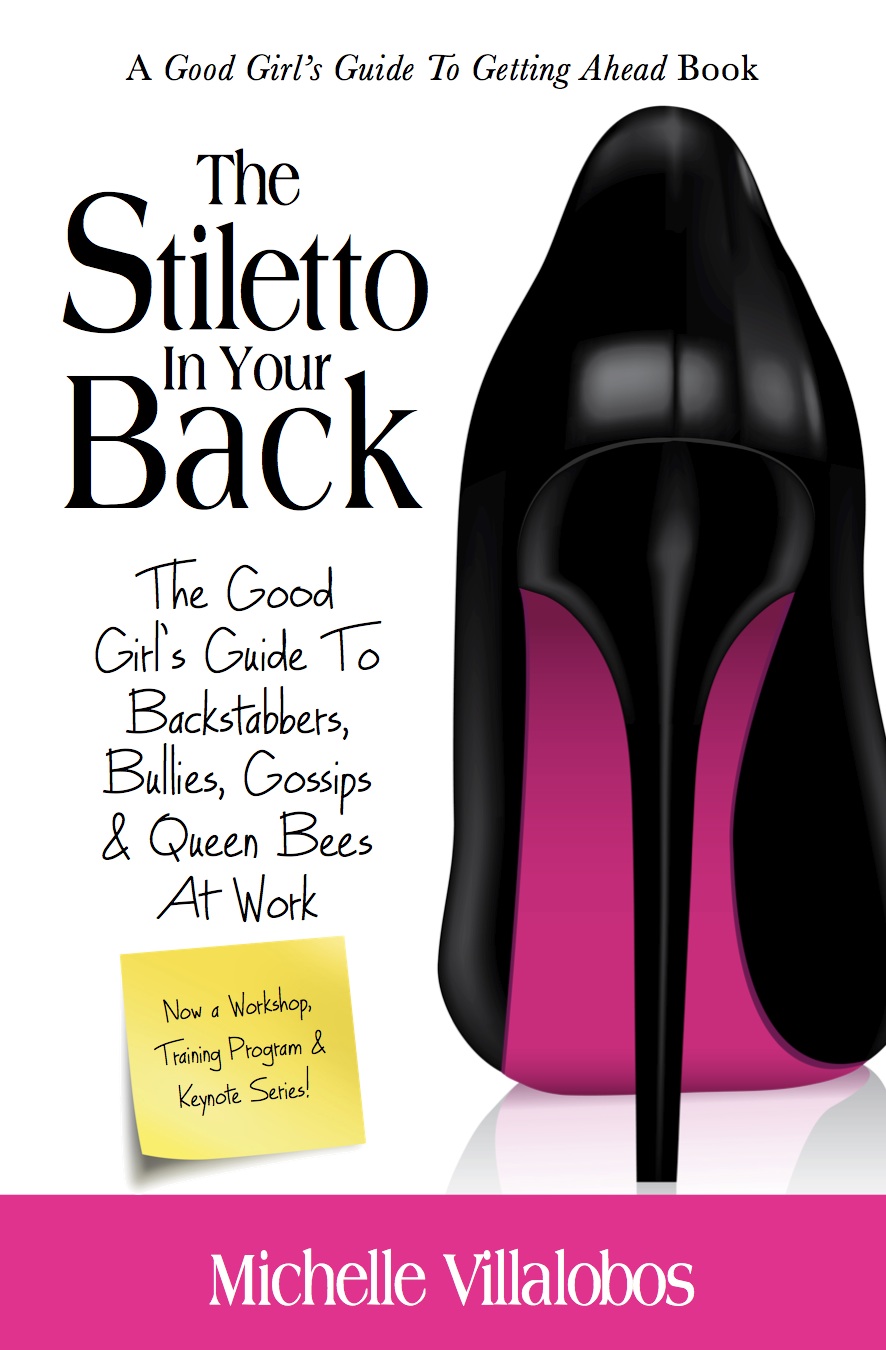
Miami businesswoman Michelle Villalobos knows this all too well. I first spoke to Michelle for a public radio story two years ago and have kept up with her online. Recently, she published a short e-book called The Stiletto in Your Back - The Good Girl's Guide to Backstabbers, Bullies, Gossips and Queen Bees at Work. She went into WLRN's Miami studios last week to talk to me about all this. The WLRN version of the story will air tonight (July 2) at 5.50p.m. and the longer, podcast version of our interview will be released next week.

Michelle has had some hellish experiences herself, but I must say they make excellent listening. There was the fashion magazine she ended up fleeing to protect herself from further backstabbing, and more recently the group business venture where one woman gradually and skillfully managed to turn all the other women against eachother and eject them one by one...Michelle was the last to go, but only woke up to these machinations just before the axe fell.

She's done a lot of research into the origins of female aggression, which I found fascinating. In short, it all goes back to the savannah - millions of years ago women couldn't be openly aggressive like men, because losing their lives in a fight put their children at too much risk. So women evolved to compete and mete out their aggression in underhanded ways, at which we still excel. 

She has advice about how to cope if you're the victim of an office bully or of unpleasant office gossip - and she strongly advises women not to share too much information about their private lives with other women at work. She says over-sharing is a huge source of workplace misery for women once a relationship sours. She also advocates calling a bully out on her behavior, but only once you are well armed with information. She concedes that in some cases the only answer may be to leave that workplace and find another, friendlier one instead - which, admittedly, may not be as easy to do as it was before 2009.

Tune into WLRN's live stream tonight at 5.50p.m. or to the podcast, which will be packed with more information - it'll be released after the holiday weekend (or you could do both - in fact, why not?)
Gagging on diversity

June 27, 2013

"My boss said, 'I've never had a skirt work for me before. I don't know what to do.'"

- Shirley Engelmeier

When Shirley Engelmeier began her career in the consumer products business in the '80s, women were still viewed with suspicion, at least in some quarters of corporate America. "People thought you were a token placement," Engelmeier told me this week, "That you got your job because you were a woman." It took Engelmeier, the CEO of consultancy InclusionINC and author of Inclusion: the New Competitive Business Advantage, several years to realize just how tricky life could be for a hardworking, ambitious young woman in sales.

"My numbers were the sixth best out of 26, and my buddy down the hall was 26th out of 26th, and he got the job," she says of one occasion. Politics played a part, as it always does. She says men hung out with other men and asked other men (and their wives) to dinner at eachother's houses. As the quote at the top shows, her boss was pretty clueless about what to do with Engelmeier. She didn't get asked to those dinners, anyway.

"I love Sheryl Sandberg, she nails the problem [of the lack of women's advancement], but her solution’s off," says Engelmeier. "Probably two decades before she was in the workforce I was raising my hand, asking for a seat at the table, and nobody cared." 

You could argue that things have changed tremendously since, giving professional women today a much better chance of being recognized when they make an effort to put themselves forward. But Engelmeier isn't so sure. We met the day after she attended a conference at The Conference Board on diversity and inclusion "and some companies still don't care", she says. I think the word 'diversity' is an automatic turnoff to a lot of white people, especially men. They associate it - and Engelmeier backed me on this - with ticking off some box HR told them they have to fill, but they don't attach any real value to it. Engelmeier says she's always "slightly depressed" after attending such conferences when she reflects on how relatively little has changed since she started thinking about all this properly in the '90s.

"After two decades of managing diversity it hasn’t worked because we didn’t link it to business…it was seen as an HR talent acquisition frenzy...and we excluded white men – men think this is for some other group, so they feel excluded and terrified," she says. (This is something that came up in show 7, 'Non-white and female'.) Engelmeier's work is all about improving business results for clients through employing teams made up of different types of people - women and people of different ethnicities (and of course a cross between the two).

"MIT researcher Tom Malone has shown diverse viewpoints will come up with a better set of outcomes, and in his case he was saying with women on the team, than [if the team were made up of] the same like-minded geniuses."

Engelmeier founded her consultancy 12 years ago and how has clients across the US and the world. Yet, she says, too many CEOs still don't get it, even while they're aware of changing demographics in the US and around the globe, and the fact that women make 80 percent of purchasing decisions. "It’s not that complicated!" she says. "Who are the key employee demographics to help you sell baby food and design cars?" Back in her own consumer goods days, diaper brands were entirely staffed by men.

Can we elevate the debate on working parenthood?

June 20, 2013

"Everything is about pretty, rich Marissa Mayer." - Jessica Grose

"Women without children are barred from the conversation about women. Not only do they not have a seat at the table but they can't even get into the restroom." - Lauren Sandler

Can we move the debate on working parenthood forward? That was the question posed by a panel of writers and commentators at The New America Foundation's New York offices last night. Note the use of the word 'parenthood' rather than 'motherhood'. Still, there was only a scattering of men in the audience.

The panelists are all well known for writing and speaking on what I'll have to call women's issues, although I dislike the term for reasons I can barely explain. Judith Warner wrote the book Perfect Madness - Motherhood in the Age of Anxiety, Sharon Lerner is the author of The War on Moms: On Life in a Family-Unfriendly Nation, Lauren Sandler is everywhere right now discussing her new book One and Only: the Freedom of Having an Only Child, and the Joy of Being One, and I used to listen to Jessica Grose regularly on Slate's Double X podcast. She now writes about things women-related for a host of publications including Slate and The New Republic.

A few takeaways from the evening:

  • The debate on working parenthood is stuck in the US for a few reasons: what Sharon Lerner called America's "rampant and deep strains of individualism" is one of them. When I moved here 17 years ago I was truly struck by how allergic to government so many people are in this country. A country that was built by individuals and has long emphasized what one person can achieve if they just work hard enough, isn't that invested in creating a uniform system of leave and childcare policy that could help everyone. Or at least it feels very ambivalent about it. 
  • Another reason may be a reluctance to talk about just how hard things are. Judith Warner said Americans are more open about their sex lives than they are about money (though having just produced a show on sex, I'm not so sure). She said the cost of pre-school is killing all but the wealthiest Americans, but that few people are talking about this honestly.
  • But things aren't perfect in Europe either. Scandinavia may be the envy of many because of its generous family policies, but in the UK, where I grew up, things are more of a mishmash. My friends get a year's maternity leave, but quality, affordable childcare is relatively hard to come by. Lauren Sandler pointed out that this situation is now playing itself out in British homes, as people apparently choose to have smaller families - almost half of British families now have just one child. 
  • The panelists discussed the fact that in the US, the debate on - heck, let's just call it working motherhood - is all about rich women like Marissa Mayer and Sheryl Sandberg. But there are millions and millions of women in this country who have almost no control over their lives and cannot take a sick day if one of their kids is sick, or they're sick, and actually get paid for it. Why do we always focus on the rich and famous? Because, according to the panelists, there is an 'aspirational' culture here that means we're always looking up. This gets me to the evil media, of which I am a member.
  • Lauren Sandler was surprised when her latest piece in the Atlantic - about female writers who had one child - was published with the headline: The Secret to Being Both a Successful Writer and a Mother: Have Just One Kid. She said readers responded mainly to the provocative headline - and the comments beneath the piece - and barely to the content of the piece itself. I was sitting next to friend and colleague Rachael Ellison of Reworking Parents and she echoed Sandler's point, saying the media has a lot to do with the so-called 'Mommy wars' or indeed the discussion around women and work in general. The whole point of a headline is to get people to read or click. I get that. But I think Rachael is right that part of the reason our debates around these issues get stuck is that editors like to focus on the things that have always riled people or always excited people because they know those articles will sell. This really needs an entire blog post to itself.
  • Finally, mothers tend to dominate the conversation on working women. Lauren Sandler put it well: "Women without children are barred from the conversation about women. Not only do they not have a seat at the table but they can't even get into the restroom." This is partly why I'm dong this show. There are so many issues to do with working womanhood that are not child-related, and I want to make sure they get covered. 

Takeaways from a S.H.E Summit

June 18, 2013

I said in the last newsletter that I'd write a little more about takeaways from Claudia Chan's S.H.E Summit, which I attended on Friday and Saturday of last week. My double level of cynicism (1. raised British and 2. a journalist) means I am almost allergic to things like group hugs, 'you go girl' sentiments, over-use of the word 'empowerment', or indeed gooeyness of any kind (that said, I did recently tweet a video of a baby elephant having a dip in the sea, so there are exceptions.)

'S.H.E' stands for 'she helps empower'. But my native cynicism was forced into retreat: there was plenty of meat at the conference. Here are a few points at which I nodded vigorously and/or got a kick out of:

  • Entrepreneur and investor Joanne Wilson (who blogs as Gotham Gal) said, "Women need to say, 'I'm going to my kid's sporting game. End of story.'" This point has come up a few times with my interviewees - that women think we need permission for things, particularly when it comes to work and our children colliding, while men will simply state their intentions and get on with it.
  • Anita Sands of UBS (a no-nonsense Irishwoman) was part of a panel on women in leadership. As part of that discussion the topic arose of how to get what you want from your boss. She made an excellent point about the importance of framing your request: "There's what you want to say, how you say it, what he wants you to say, and how he wants to hear it." That's four different things to mull over before going into the discussion. But considering each one of them should take you that bit further toward getting what you actually want. 
  • When it comes to mentorship, "lead by giving" said one of the panelists. "Think about what you can give other people – make someone want to invest in you by giving to them first." I need to get on that.
  • The final panel on Saturday focused on working mothers. One of the points made was how important it is for women to say no to things. Otherwise, you get eaten up by other people and have absolutely no time for yourself - and panelist Latham Thomas made clear that you don't need to add excuses to your 'no'. "No is a complete sentence," she said. Something I particularly enjoyed hearing came from Cortney Novogratz, who owns an achingly cool design firm with her husband and is also mother to seven children. Yes, seven. 'It takes a village' is a bit of a cliché , but in her case, it really does. She said their last family holiday card had a photo not just of the immediate family but of grandparents, godparents, nannies and others who help her family stay on track (and keep her sane). I love the fact that she honored all these people who help her bring up her brood in such a public way.