Are female bosses evil? Really?

March 4, 2013

I once had a female boss from hell. It is no exaggeration to say she made her underlings' lives miserable. Not every day - much depended on her mood (and her alcohol intake at lunch), but many days you could feel the poisonous atmosphere hovering over the room about five of us occupied. You didn't have to be a psychologist to tell this woman was extremely insecure. She had landed her position because of, shall we say, connections with a certain male executive in another part of the company. She rose from secretary to manager very quickly without any chance to learn the ropes. She was, at heart, a good person, but once inside that roiling cauldron of politics and power plays that was the office, she was horrible, undermining people, but mostly women, at every opportunity.

So when I read this piece in The Wall Street Journal it rang bells. It also left me depressed because of all the stereotypes it brings up. According to the article, 'queen bee syndrome' is alive and well and women are still being bitchy to other women on a regular basis, in some cases deliberately wrecking their careers. This is the opposite of what Catalyst, the non-profit that promotes women in business, reported when they released a study last year stating that queen bee syndrome was false (though naturally they would want their study to reach that conclusion). The Journal piece echoes my conclusion about my former boss: that insecurity is at the root of this problem.

But maybe at least some of this is in our heads. The WSJ article points out a few things that may be part of the reason why women bosses get such a bad rap. I will touch on this in my next show, but it's worth stating here: women judge women bosses more harshly than they judge male ones. Both sexes expect certain 'caring' behaviors from women, and when they don't manifest themselves, we don't like it (see under Mayer, Marissa). Another point the piece makes is that some women do not listen to a woman boss the same way they do a male one. We are so used to drinking society's Kool-Aid about what men and women should be and do that we ourselves don't even respect a female in a leadership role.

I believe women in senior positions at work do tend to be more insecure than men in the same positions because of all the things we talk about on The Broad Experience: centuries of social norms telling us we shouldn't have power and don't know how to handle it, subtle or not-so-subtle messages from our families, and continuing ambivalence to us in the workplace itself. 

But what about the male bosses who have driven you nuts with their conniving and petty insecurities? And what about the great female bosses, like the ones who changed my (sexist) mind about the species? Thanks to Louise Chin and Ruth Shapiro of the Museum of Modern Art, who restored my faith in female managers by being fair, firm and, in Ruth's case, giving me a much needed telling-off one day. She taught me a lesson I needed to learn about not squirreling out of tricky situations with customers (thanks Ruth). And hats off too to Lynn Bolger of APL Digital, which was quite a frat house in the late '90s. Lynn always kept her sense of humor and sanity while surrounded by testosterone, and treated everyone fairly.

What we surely need for 'queen bee syndrome' to go away is workplaces (i.e. people) that genuinely treat everyone the same, and a society that deems it acceptable - no, encourages, women to excel at work as much as in any other area of their lives.

Sheryl Sandberg and the politics of leaning in

February 22, 2013

I was up earlier than usual today and read this New York Times piece on Sheryl Sandberg's plans to revolutionize women's career progress at about 7a.m. It already had several comments then. As I type, seven hours later, the count is up to 500.

Sandberg really gets people talking.

She's also beginning to polarize people. I'll be honest: most of the reason I started The Broad Experience is because, like Sandberg, I believe women are really good at sabotaging ourselves at work without even realizing it. I have done this time after time. I made career mistakes that I had no idea were mistakes. If you'd told me even five years ago that talking up my achievements at work was a good idea, I would have been horrified. How vulgar! Good work, I had always been told, spoke for itself. There was no need to hammer on about how wonderful you were. 

Wrong. If you don't underline your achievements to the people who matter, don't be surprised if you're passed over for promotions. I believe everything Sandberg says about 'leaning in', speaking out, etc. In short, I am a recovering career mess. But she makes some people's blood boil. For one thing, all this advice is coming from the mouth of a multi-millionaire who has tons of household help and had an elite education. What about 'earthbound women', as the Times' writer, Jodi Kantor, refers to us? The other thing is that many are angry that Sandberg appears not to address the other side of women's (lack of) progress in the workplace: government policies, corporations themselves and the existing old boys' clubs that would like nothing more than for everything to stay the same. Thre are lots of comments on the Times piece by women who claim they've done everything right but still can't get where they want to be. This piece by Avivah Wittenberg-Cox in the Harvard Business Review takes a frustrated swipe at Sandberg.

I can see how Sandberg's 'Lean In circles' could also raise eyebrows. Here's a quote from the Times article:

...“Lean In Circles,” as she calls them, in which women can share experiences and follow a Sandberg-crafted curriculum for career success. (First assignment: a video on how to command more authority at work by changing how they speak and even sit.)

Having reported on the way women speak, I know how polarizing anything to do with changing ourselves can be. As far as many women are concerned, women should not have to change a thing about ourselves: society, instead, needs to get used to us. Despite being 51 percent of the population, we're still not society's default setting. Men and male-run companies, these critics say, need to adapt to the female way of thinking and acting. (But that quote reminds me to book Harvard's Amy Cuddy for the podcast as soon as possible.)

I disagree. Yes, it's aggravating and unnatural to have to adapt ourselves to the male way of doing business. But business has been male for hundreds of years. It will not change overnight, no matter how much 'soft skills' (bleurgh) are said to be a vital part of our new world. We can't just sit here and hope the male mindset will suddenly alter and adapt itself to us. The business world will become more feminized, but only when more of us are running it. For more on making male management more aware and appreciative of the way women *tend* to think and do things, check out Caroline Turner's work at Difference Works. She appears in episode 9 of the show on ambition and power.

I have tried to book Sandberg for The Broad Experience, but this week her publisher declined my request for an interview, claiming her slate was full. So instead I plan to convene a panel of women to discuss the book and use that debate as a podcast in itself.

Another aspect of this, of course, is that so many women are out there juggling away like crazy but are virtually unaware of the Sandberg and Anne-Marie Slaughter debates. They don't have time to be aware of them. They're just trying to get through their days, dysfunction and all.

Women in tech: will female startups save the world?

February 19, 2013

Some of you who have been listening to the show since the beginning may remember my third episode on women in tech. Writer, teacher, entrepreneur and provocateur Vivek Wadwha was one of the interviewees for that show. I spoke to him, Gina Trapani and Adda Birnir about the obstacles faced by women working or wanting to work in the tech field, the joys of working in tech, and why, for some women, it has an image problem. Today, Vivek posted this article on LinkedIn. It deals with the question of the lack of women in Silicon Valley's startup world, what's changing and what more can be done. He has been researching this topic in conjunction with the Kauffman Foundation, which devotes itself to entrepreneurship. He's pretty optimistic about women 'saving mankind' as he says. I'm too British to use such over-the-top language myself, but his views are well worth reading. 

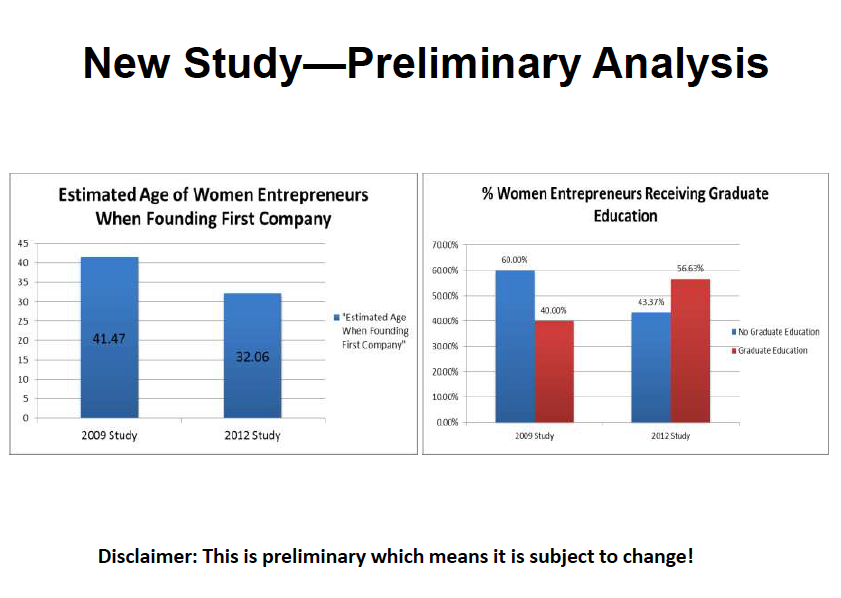
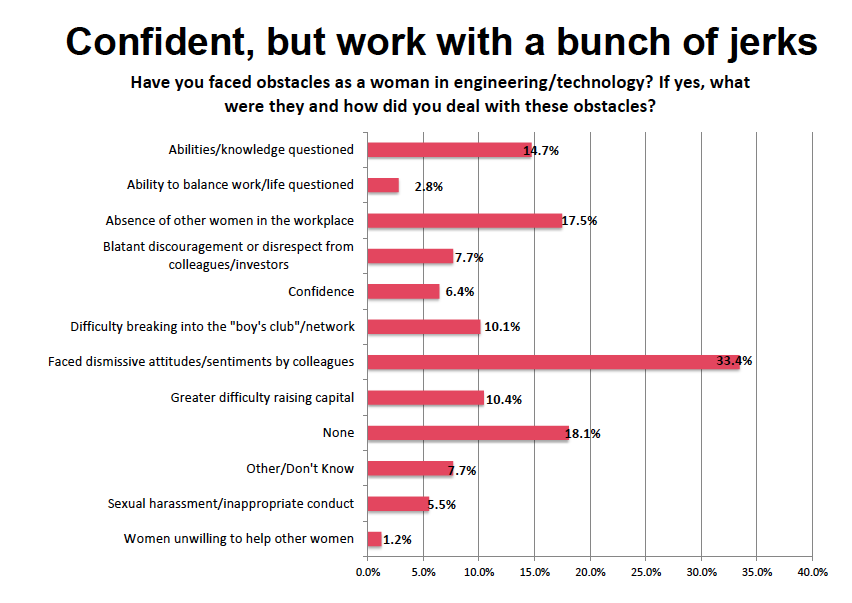
His team and Kauffman did a survey of 500 women founders, which he discussed at last week's Women 2.0 conference. He emphasizes they're still analyzing the reults. He has given me permission to post a couple of slides from his presentation here. Further down the page you can hear a snippet of Vivek talking to me last year about the reactions from some women when he began to speak out about the lack of women in Silicon Valley.

This first slide shows preliminary resutls suggesting the average age for women starting companies has dropped quite a bit, and that compared to several years ago, many more female entrepreneurs have master's degrees.

Then there's this slide, which asks what kinds of obstacles, if any, the women founders have faced. The most reported? Dismissive attitudes from colleagues.

 Vivek says he is also considering "crowdsourcing a book about the challenges women face in the technology world, how we can correct the imbalance, and the great opportunities that lie ahead." Follow him on Twitter at @wadhwa to keep up with his project(s). And here's that audio snippet from last year.

The story behind The Broad Experience logo

February 17, 2013

One of my main short-term goals for The Broad Experience has been to find a brand identity for the podcast. It's been tough. I knew what I didn't want - any hint of pink, sexy stereotypes, or clichéd woman-with-briefcase-and-baby images  - more than what I wanted. I just knew I wanted something distinctive that somehow summed up, for me, what The Broad Experience is about. I started working with designer and Broad Experience listener Christy Carroll early in the winter. She had me fill out a long questionnaire about the impetus for the show and what I wanted a visual identity to convey. Ultimately, what I've ended up with is something quite different than what I expected to like.

Generally I'm a lover of simple, clean fonts. But when I saw the early version of this design with the word 'broad' in such a different font, I was immediately attracted to it. American listeners know 'broad' is old-fashioned slang for woman, but it's one of the few such words that doesn't reduce us in some way. I loved the way Christy had made 'broad', well, broader than the other font, but also given it a slightly retro, '50s, feminine look. As my mother pointed out, part of what I'm doing with the show is talking about the way things have, and haven't, come on since the 1950s. She also said "turquoise was a very '50s color" (she was there). I'd had no idea, but I am drawn to all kinds of blues and greens. The woman in the lightbulb came from something I'd said to Christy, which is that The Broad Experience is a show about ideas. The figure was originally a reproduction of the female figure you see on a bathroom door. I wanted something a bit less generic, and Christy provided.

This broad is very happy with the new identity.